Risk analysis identifies specific threats and vulnerabilities within your organization’s cybersecurity environment, allowing you to prioritize investments in protection where they make the most sense for business continuity and minimizing financial losses.
Identification, analysis, and risk management are complex activities that require in-depth knowledge of the organization. Risks often involve a large number of diverse assets, which are exposed to an even greater number of threats.
RiA (Risk Management and Risk Analysis) is an information system designed to identify, analyze, and manage risks within an organization.
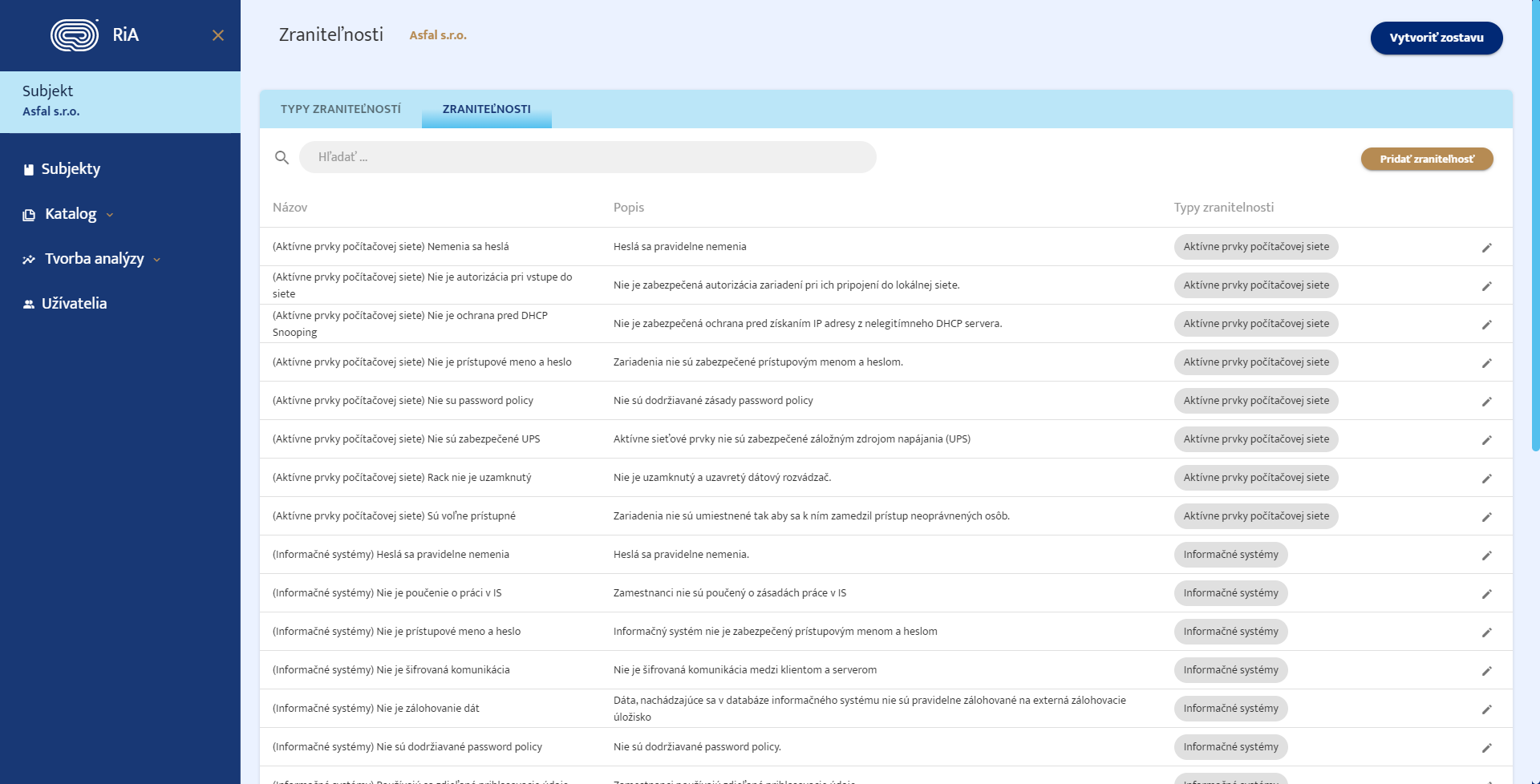
The system enables the management of assets, vulnerabilities, threats, measures, relationships, risks, and risk owners, allowing organizations to design and implement effective measures to mitigate and eliminate these risks and cybersecurity threats.
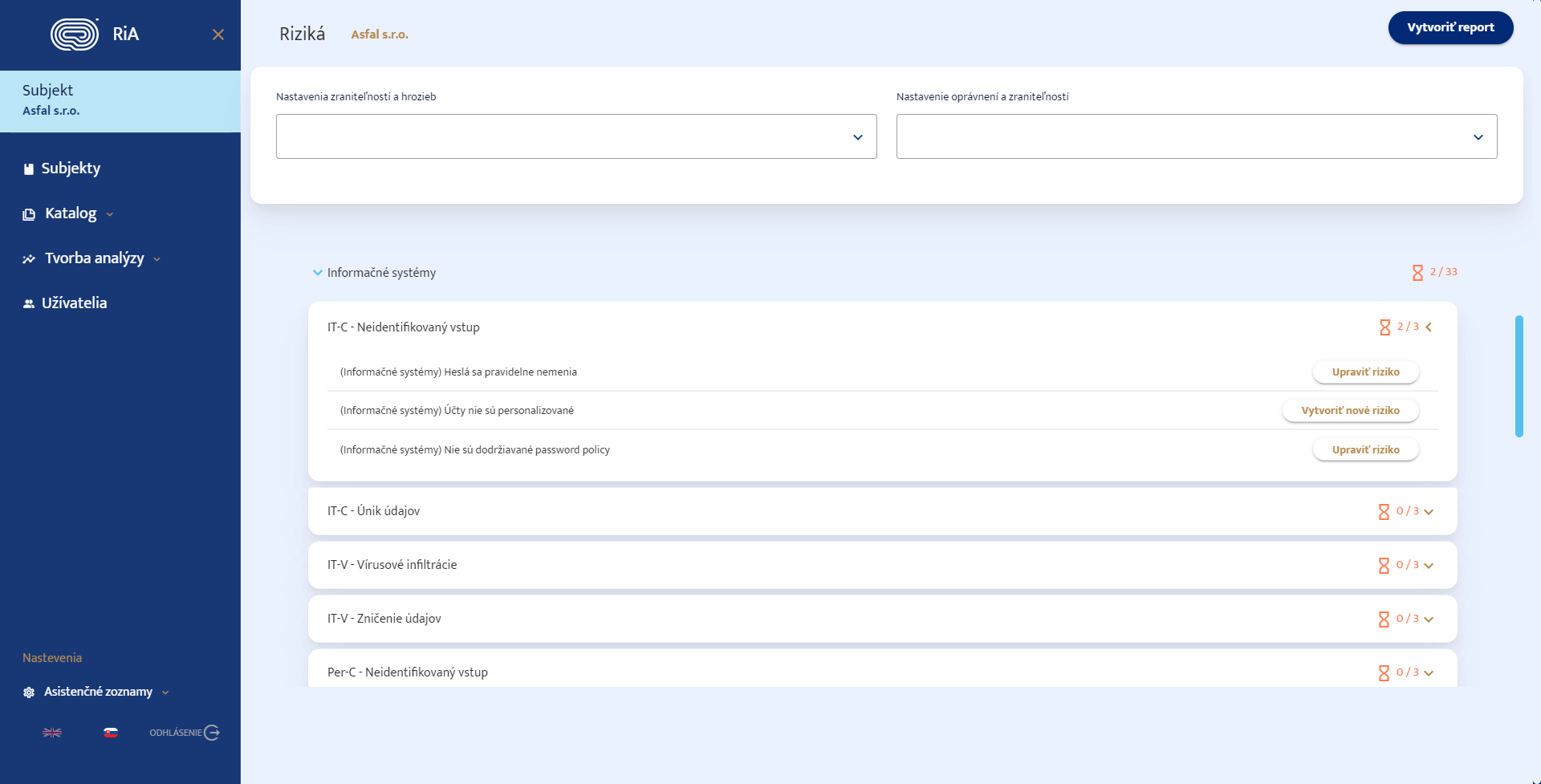
RiA is designed to provide organizations with a simple and clear approach to identifying, analyzing, and managing risks. It allows tracking the development of risks and measures for their mitigation in real time, enabling organizations to respond quickly and effectively to new and evolving threats.
Key Features of RiA:
- Web interface providing simple and transparent access to all system functions, with outputs in PDF reports.
- Management of assets, asset owners, vulnerabilities, threats, measures, relationships, risks, and risk owners.
Not only do organizations evolve, but the conditions in which they operate also change, and so do the risks they must manage. Risk analysis and understanding how risks change over time are essential factors for establishing measures that are both economically sustainable and, above all, effective.
"RiA represents a unique tool for executives, cybersecurity managers, and asset owners."
System Architecture:
RiA is built on a standard three-tier architecture: web layer, service layer, and data layer.
- The web layer provides the user interface and handles user authentication and authorization.
- The service layer provides access to core data about the organization and its assets, risk creation and editing services, a measures registry service, and a service for generating formalized outputs.
- The data layer stores information about assets, risks, and measures.
“The role of the RiA system is not only to compile a risk analysis and support risk management but, above all, to enable real-time monitoring of the development of risks and the measures taken to mitigate them.”
Web Layer
Provides the user interface and manages user authentication and authorization. It is implemented as a reactive web application accessible via modern browsers without special requirements.
Service Layer
Implemented as a separate server application, it provides essential functionality to the web application, including:
- Management of the organization’s inventory (assets, vulnerabilities, threats, and measures).
- Management of the risk register with severity attributes.
- Reporting services (formalized outputs).
Data Layer
Implemented as a NoSQL database, enabling efficient storage of data with tree structures or complex document structures. It can run on most modern Windows and Linux systems.
"Comprehensive risk management allows for truly efficient control of financial and time costs."
Delivery and Installation:
RiA is offered in two main formats:
- Standalone delivery – the system is delivered as a virtual machine image with RiA preconfigured and ready to use.
- Software as a Service (SaaS) – RiA functionalities are provided as a service by the system’s author and administrator.
SOMI Systems a.s. provides implementation, training, and full support for the RiA information system.